AI Assessment Scale (AIAS)
A practical framework to guide the appropriate and ethical use of generative AI in assessment design, empowering educators to make purposeful, evidence-based decisions.
About the AIAS

The AI Assessment Scale (AIAS) was developed by Mike Perkins, Leon Furze, Jasper Roe, and Jason MacVaugh. First introduced in 2023 and updated in Version 2 (2024), the Scale provides a nuanced framework for integrating AI into educational assessments.
The AIAS has been adopted by hundreds of schools and universities worldwide, translated into more than 30 languages, and is noted by the Australian Tertiary Education Quality and Standards Agency (TEQSA) in its
2024 paper as an option to assist with implementing GenAI into assessment.
Understanding the Levels
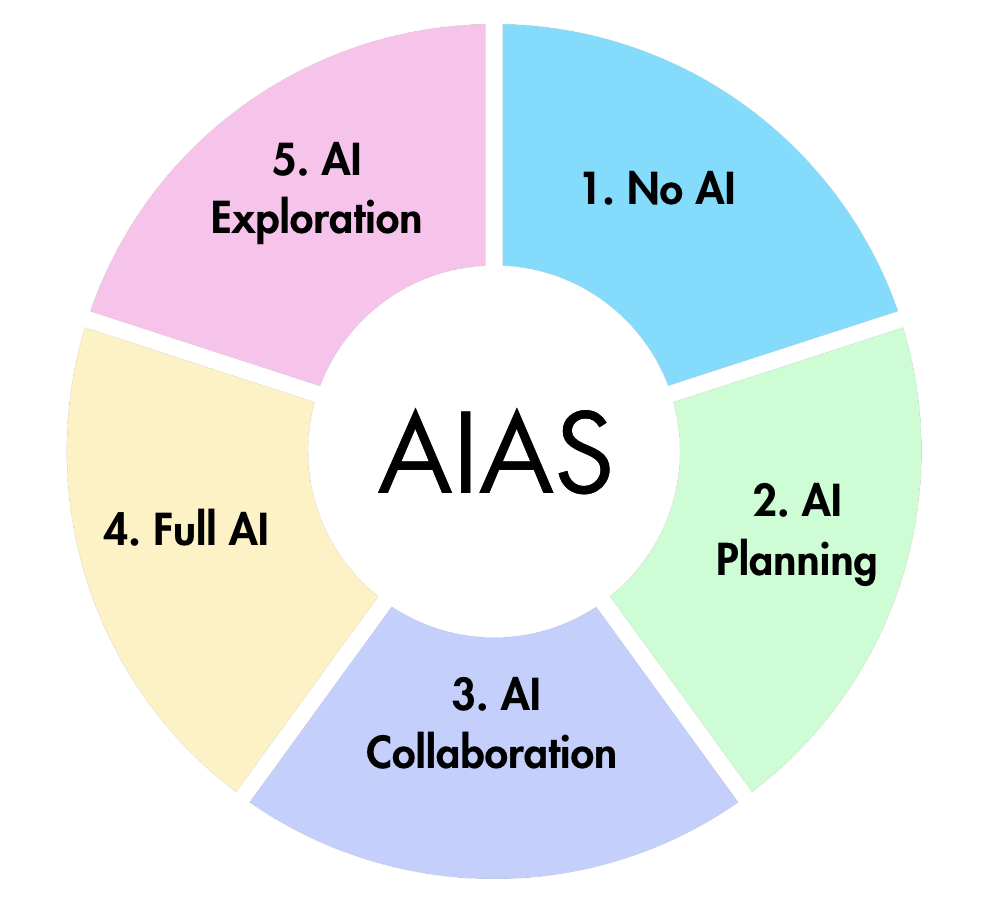
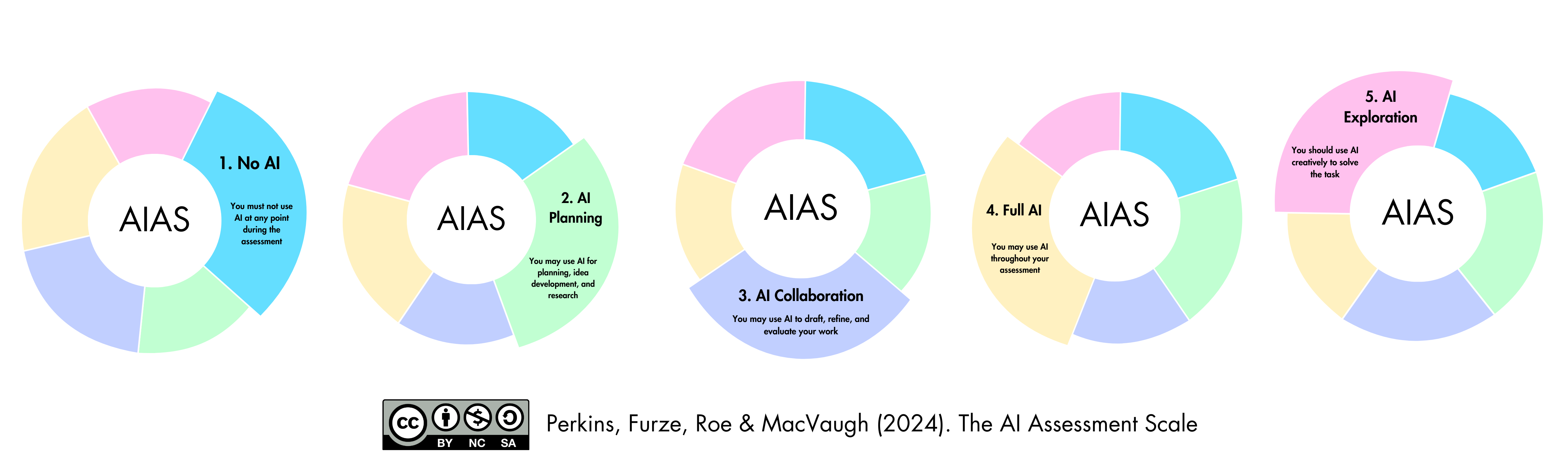
1. No AI
The assessment is completed entirely without AI assistance in a controlled environment, ensuring that students rely solely on their existing knowledge, understanding, and skills
You must not use AI at any point during the assessment. You must demonstrate your core skills and knowledge.
2. AI Planning
AI may be used for pre-task activities such as brainstorming, outlining and initial research. This level focuses on the effective use of AI for planning, synthesis, and ideation, but assessments should emphasise the ability to develop and refine these ideas independently.
You may use AI for planning, idea development, and research. Your final submission should show how you have developed and refined these ideas.
3. AI Collaboration
AI may be used to help complete the task, including idea generation, drafting, feedback, and refinement. Students should critically evaluate and modify the AI suggested outputs, demonstrating their understanding.
You may use AI to assist with specific tasks such as drafting text, refining and evaluating your work. You must critically evaluate and modify any AI-generated content you use.
4. Full AI
AI may be used to complete any elements of the task, with students directing AI to achieve the assessment goals. Assessments at this level may also require engagement with AI to achieve goals and solve problems.
You may use AI extensively throughout your work either as you wish, or as specifically directed in your assessment. Focus on directing AI to achieve your goals while demonstrating your critical thinking.
5. AI Exploration
AI is used creatively to enhance problem-solving, generate novel insights, or develop innovative solutions to solve problems. Students and educators co-design assessments to explore unique AI applications within the field of study.
You should use AI creatively to solve the task, potentially co-designing new approaches with your instructor.
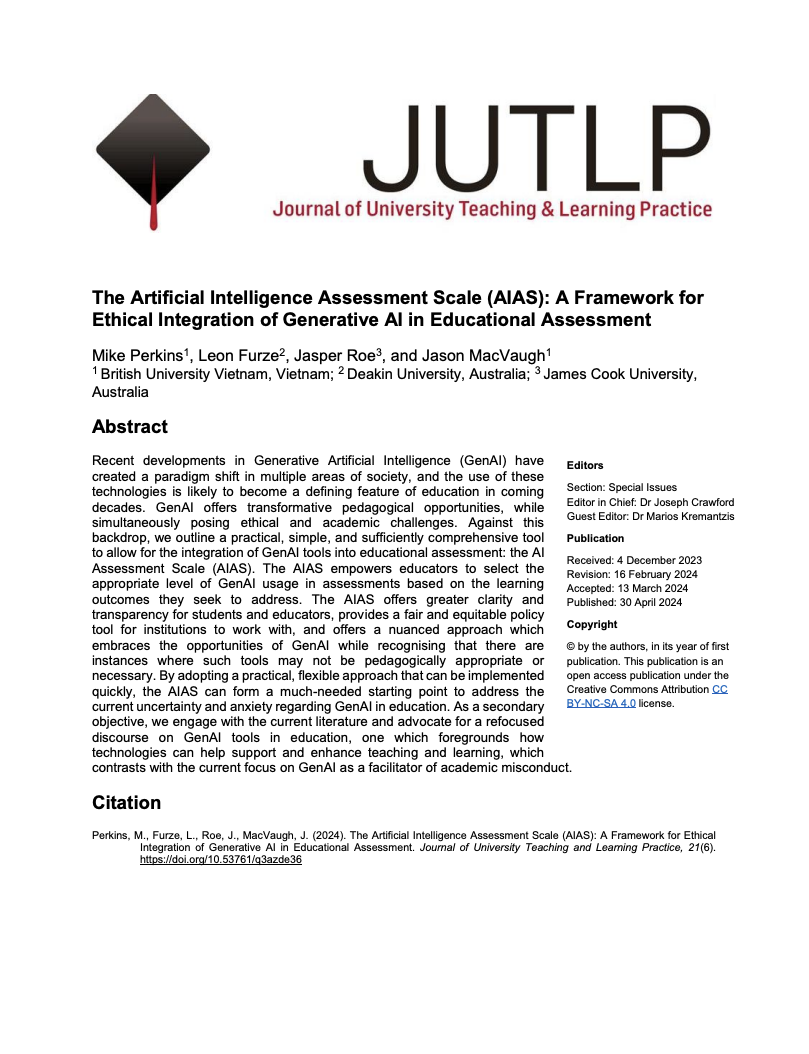
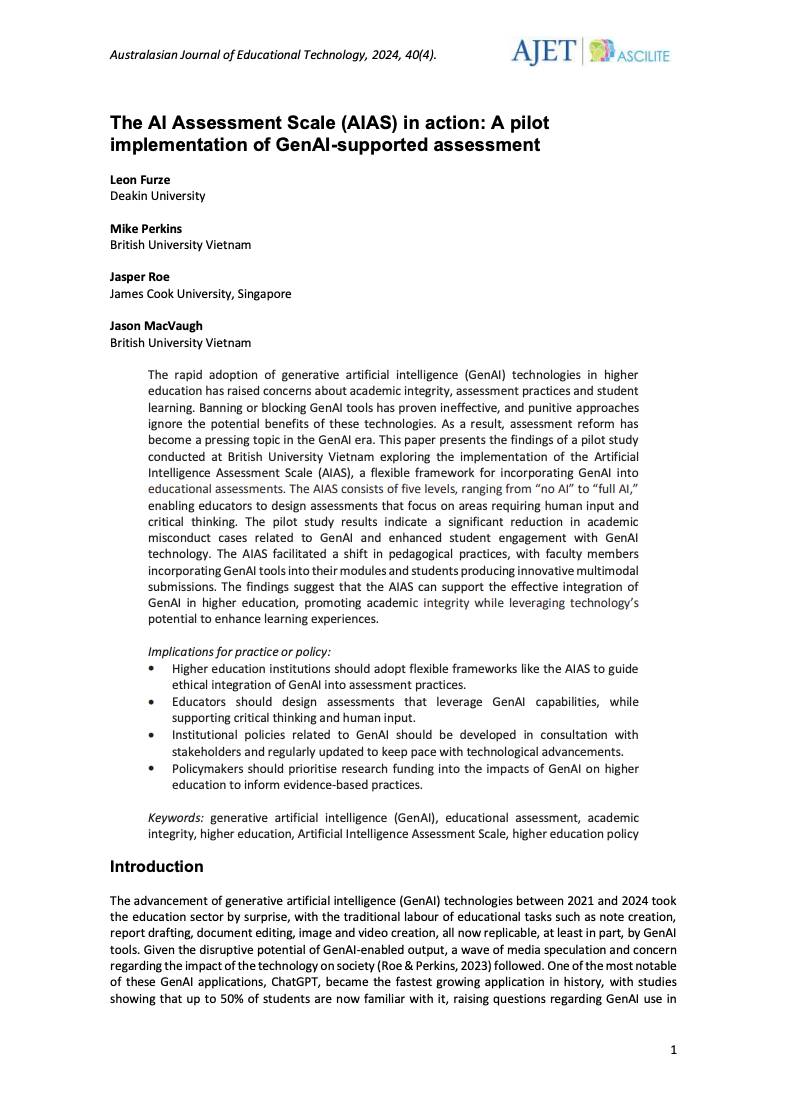
Research Papers




Resources
Design Assets
The AIAS is open access under a CC BY NC SA 4.0 license. Access all of the editable design assets here.
Translations
The AIAS has been translated into 30 languages. Read about the translations and find resources for all of the languages here.
Custom AIAS GPT
Interact with a Custom GPT chatbot designed to guide educators through implementing the AIAS.
AIAS Authors
If you are interested in submitting data on your implementation of the AIAS to be included in an open repository for further study, want to tell us how you are using the AIAS in your institution, or have any questions, please get in touch with us.

Mike Perkins

Leon Furze

Jasper Roe

Jason MacVaugh